The truth about pocket spring mattresses: what 15 years of returns taught me

I discovered that most pocket spring mattresses are flawed
I've been making mattresses for 15 years now, and I've probably opened up more failed mattresses than anyone should have to. It's given me a pretty unique education. Every returned mattress is basically a lesson in what went wrong. And what I learned completely changed how I think about pocket spring mattresses.
Most manufacturers focus on the fancy marketing features (cooling gel, zoned support, proprietary foam names). Meanwhile, they're getting the fundamentals completely wrong. I know this because I made the same mistakes myself, and it cost me thousands in returns before I figured it out.
The 600-spring disaster that changed everything
Here's the story that taught me the most important lesson: I once ran out of springs and had to use a different supplier's pocket springs. They turned out to be 600 pocket springs in the unit. I got so many returns.
That's when I realised something critical. If I was getting more returns from having fewer springs, maybe if I increased the springs, I would get even fewer returns. So I looked at Vispring (which has been operating for 90 years) and others. All of these older companies did one thing the same: they used higher coil counts and six turns. The "VI" in Vispring means "6" spring, as in 6-turn spring.
I landed on 986 springs for a queen-size. The industry standard? 768 springs. That's a 30% increase. Higher pocket spring counts are rare because they fall outside the normal economies of scale. If you increase spring count by 20%, it can increase the price by 200%. This is why they are so rare.
However, I have taken the leap, and my returns have decreased substantially. Reduction in returns is the only real data we have available that will help us determine if something is actually working for people.
Not all pocket springs are made equal
Our spring system uses a honeycomb layout for better weight distribution and long-term durability.
Understanding different types of mattress springs
Pocket springs vs. Bonnell springs vs. continuous coil
I would never consider sleeping on what I prefer to call "cage springs" (bonnell springs or continuous coil systems where the springs are joined with steel at the top and bottom). In theory, pocket springs are supposed to be better at wrapping around your body, which means they distribute pressure more evenly. This is called increased point elasticity.
But here's the catch: a lot of pocket springs these days aren't designed well, so they don't work as intended. They glue non-woven material to the top of the springs, which makes them act like regular springs anyway. Every single pocket spring mattress I've opened from big retailers has non-woven fabric glued top and bottom, which in my eyes makes them perform as a bonnell spring would anyway.
Pocket springs have more potential for higher point elasticity than cage springs, but in the real world, it rarely happens. A well-designed continuous coil can potentially be better than many poorly designed pocket spring options.
The three things that matter in coil mattress construction
1. Number of springs (I use 986 vs industry standard 768)
Absolutely critical. Make the diameter too small and the mattress gets really heavy, too big, and it's gonna be uncomfortable. It's like mattress resolution: more springs is higher comfort resolution until there are diminishing returns. Most mattresses have too few coils, which is one reason why most mattresses suck.
2. Edge support (I ditched foam boxes after seeing mould)
When I started seeing mould under the mattress, I stopped using foam boxes. Never saw mould again. Coils all the way to the edge mean air all the way to the edge. The top layers are a big sponge, and having wire to the edge will promote the drying of the upper layers.
Foam boxes look better in the showroom and feel more solid when you sit on the edge, but ventilation suffers. I'd rather have a mattress that breathes properly.
3. Choosing spring tension for your body weight
This is the most critical part, and it's something almost nobody talks about because it doesn't market well. Medium and firm are our standard spring units. Soft springs are available by request for children and people under 50kg, but they are too soft for most adults. The difference? Just 0.1mm of wire thickness.
If I keep the same number of springs and change the thickness of the steel by 0.1mm, it will feel like a different mattress.
Here's why this matters: If you are too light for the springs, they won't yield to your body. Instead, your body will yield to the springs. This causes the body to contort and stretch during the night. If you are too heavy for your springs, you will have a hammocking effect, and your body will fall out of the middle of your range of motion. This would be a perfect example of "lack of support."
Changing the springs works every time
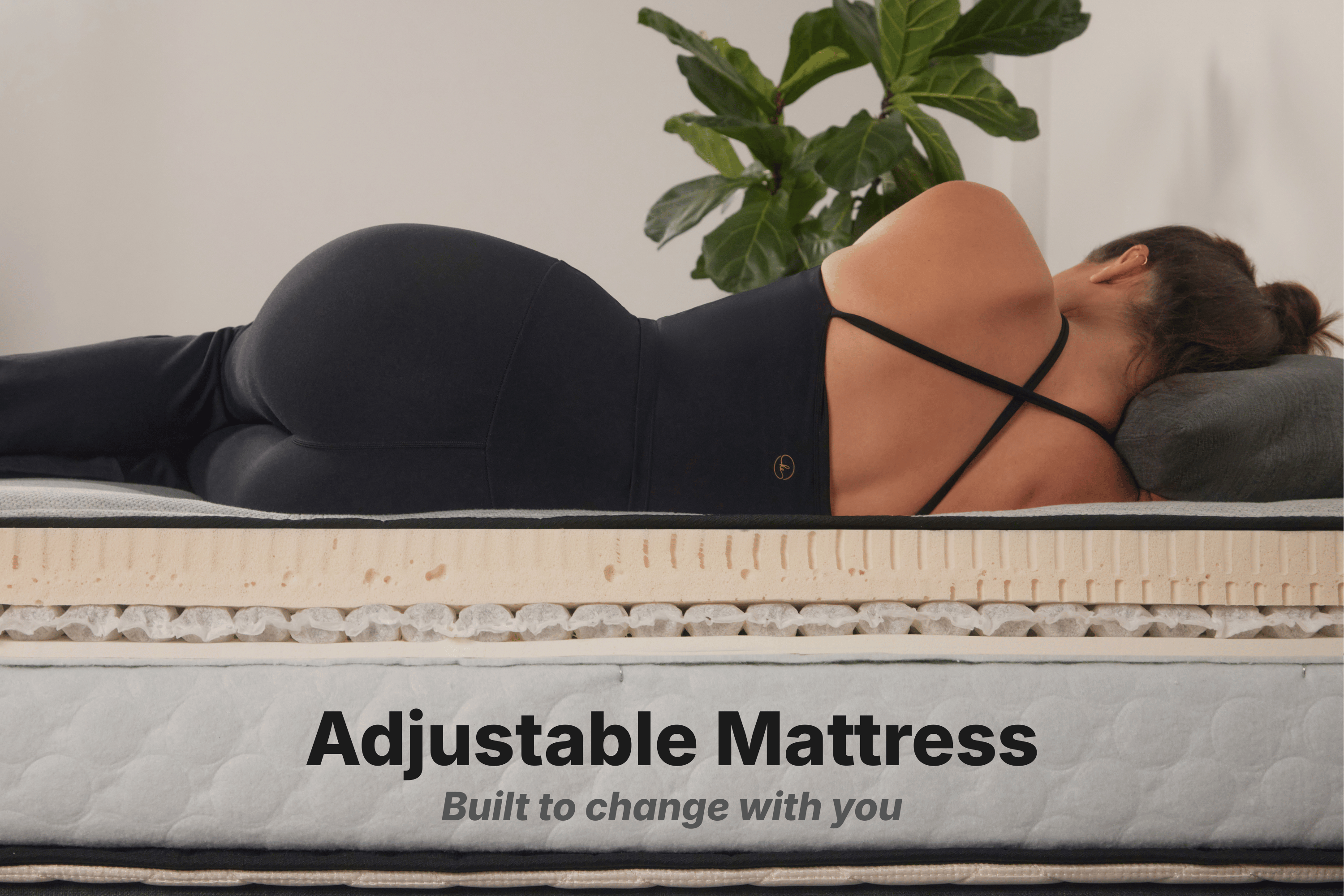
I went a step further than most bed-in-a-box companies (who'll struggle with this due to logistics). I made the springs swappable. I've found that the biggest determining factor of mattress comfort lies in the spring tension to bodyweight/body shape.
We drive out and adjust the spring by 1/10th of a mm in thickness to adjust it to people's personal preferences. We found that changing the foam kinda worked sometimes, but mostly it didn't work very well. Changing the springs works every time.
The number of mattresses I've opened with dead foam and pristine springs is crazy. It's never the springs. It's always the plastic foam. Springs are extremely resilient (of course, they have to be designed right in order to be resilient).
Heat: Memory foam vs. innerspring mattresses
Pocket springs are 1.2 kg/m³ in density. Memory foam cores are around 50 kg/m³. That means springs store 62 times less heat than foam. The more foam, the more heat. The springs are just air, and air is poor at storing heat. It's actually dissipating the heat.
This is why all those bed-in-a-box companies eventually moved from pure foam mattresses to hybrid mattresses with springs. They weren't trying to do the next "new thing." They were trying to stop the returns. Returns literally kill mattress companies.
What to look for in a pocket spring mattress
Forget about what the springs are made of (titanium, vanadium, whatever). I have never experienced a pocket spring failure. What matters is:
-
High coil count (look for 900+ springs in a queen, not 600-768)
-
Proper edge support (springs to the edge, not foam boxes)
-
Spring tension matched to the surface material and body weight (this is critical and rarely available)
Keep in mind, simply getting a higher coil density will not guarantee success. If you have a high coil count but the springs are too firm (or soft) for your bodyweight, then it doesn't matter how many coils there are.
Latex and weight-matched springs
Your body weight is the starting point for spring tension. Everything else (the comfort layers, the foam type, the cooling technology) is secondary to getting this right.
All just my opinion, of course, based on 15 years of opening up failed mattresses and tracking what actually reduces returns. Let me know how it goes :)
Durability and material breakdown
I pull apart old mattresses regularly to diagnose issues. Memory foam is always very soft around the hip area after 4-5 years of use. The foam loses resilience where your body weight concentrates night after night, creating a permanent dip. Heavier sleepers see this happen faster; lighter sleepers get more time, but it's inevitable with plastic-based foams.
I have yet to see natural latex lose its resilience. Not once. When someone calls to say their latex mattress has dipped, it's always the pocket spring units underneath or the base that's flexing, never the latex itself. Latex just destroys both memory foam and polyfoam in terms of mattress construction durability, and it's not even close.
Temperature regulation and sleep quality
Memory foam is heat-sensitive: softer in summer, firmer in winter. Customers would call me complaining about the temperature-related firmness changes throughout the year. The foam also has slower heat dissipation because it's dense plastic with small bubbles.
Natural latex has larger open cells that allow better airflow. Even at half the density of polyfoam, latex feels cooler in my testing. I've had customers insist that polyfoam would be cooler, so I've swapped their latex for polyfoam. Every single time they've called back asking to switch back to latex. The difference is noticeable.
The coolest mattress is actually the spring unit itself. Metal wires don't store body heat. That's why I use minimal foam on top (just 5cm of latex) so the pocket springs can breathe. Adding thick memory foam layers turns your mattress into an insulator.
Motion transfer and partner disturbance
Memory foam does win on motion isolation. It's the champion when it comes to reducing partner disturbance. The slow-recovery property absorbs movement, so light sleepers don't feel their partner rolling over.
However, you can achieve excellent motion isolation with pocket springs by using individual springs in their own fabric pocket that move independently. My pocket spring mattresses use Marshall coils (individually-pocketed springs) that prevent motion transfer between different areas of the bed. Combined with the latex's natural damping properties, you get better motion isolation than most open coil or continuous coil spring systems while avoiding memory foam's heat and durability problems.
Pressure relief and spinal alignment
Here's where latex truly outperforms memory foam. Memory foam provides initial pressure relief, but as it softens over time, you sink deeper and lose proper spinal alignment. I've seen this pattern hundreds of times. Customers start with good support, then within a year or two they're waking with back pain because they're bottoming out onto firmer springs or the support layer.
Latex maintains consistent pressure relief because it doesn't soften like memory foam. The material pushes back into the contours of your body with the same force year after year. Combined with properly tensioned pocket spring systems matched to the surface material and body weight, you maintain spine aligned positioning throughout the mattress's life.
The "stuck" effect of memory foam also bothers many sleepers. They can't easily shift positions at night. Latex allows natural movement while still conforming to pressure points.
Mattress types and material composition
Memory foam is methylene diphenyl diisocyanate (MDI) combined with polyols and other additives derived from crude oil. When its life ends, 50kg of plastic sits in a landfill for centuries.
Natural latex is 95-97% polyisoprene, a natural elastic polymer from rubber tree sap, plus small amounts of proteins, lipids, and carbohydrates. It biodegrades at the end of life. The rubber trees continue absorbing CO2 for 20+ years while producing latex, making it one of the most sustainable comfort materials available.
Some very high-end memory foam (like Tempur) lasts longer than cheaper ones, but it still doesn't match latex durability and still has the heat-sensitive properties. Plus it costs significantly more than natural latex at that quality level.
Evaluating spring systems and latex combinations
The most important question isn't the brand name; it's whether the pocket spring systems are matched to the surface material and body weight. Ask these questions:
About the springs:
- How many springs are in the mattress? (Look for at least 800-1000 for a queen)
- What is the spring type? (Pocket springs provide better support than open coil or Bonnell springs)
- Do they select the spring tension using the surface material and body weight?
- Are they continuous coils, Marshall coils, or another configuration?
Many mattresses have respectable spring count but use spring technology that doesn't match different body weights. I've seen expensive mattresses with 1,000+ springs that still cause back pain because the spring tension was wrong for the sleeper's body.
About the latex:
- How thick are the comfort layers?
- Is it natural latex or a synthetic blend?
- What density is the latex? (70 kg/m³ is good quality)
If the company can't answer these questions clearly, that's a warning sign. Mattress types should be definable by their components, not just brand names.
LaurieE and their partner switched to the Aurora specifically for its spring and latex construction:
“We were specifically after a bed that would not generate heat. After one week, we are extremely happy and enjoying cooler nights. The innersprings and the thin layer of latex are keeping us both cooler.”
— LaurieE, ProductReview
FAQs about pocket pprings
What are pocket springs?
Pocket springs are individually wrapped coils, each enclosed in its own fabric pocket. Unlike traditional "cage springs" (bonnell springs) that are connected by wires, pocket springs work independently to contour to your body. Each spring can compress without affecting its neighbours, allowing for better pressure distribution around your shoulders and hips.
How are pocket springs different from regular springs?
Regular springs (cage springs) are joined together with steel at the top and bottom. Pocket springs operate independently. In theory, this independence creates "point elasticity", the ability to conform and respond to pressure at a specific point without affecting surrounding areas. However, many pocket springs today don't deliver this benefit because manufacturers glue non-stretch fabric to the top, making them act like regular springs anyway.
How many pocket springs should a mattress have?
For a Queen size, look for at least 900-1000 springs. For a King, aim for 1,100 or more. Higher spring counts are better but rare because they cost significantly more to manufacture. If you increase the spring count by 20%, the price can jump by 200%. At Ausbeds, we use 986 springs for Queen and 1,160 for King in a honeycomb pattern. That's 30% more springs than traditional straight-array layouts.
Does a higher spring count always mean better?
Not necessarily. Spring count is critical, but spring tension matched to your bodyweight is even more important. A mattress with 600 springs at the right tension for your weight will be more comfortable than 1,200 springs at the wrong tension. If you're too light for the springs, your body will yield to them instead of the other way around. If you're too heavy, you'll "hammock" and lose proper support.
What's the ideal spring tension for my body weight?
Pick the mattress by how you sleep, then choose the springs for your body weight:
- Cloud: medium springs below 80kg, firm springs from 80kg.
- Aurora: medium springs below 100kg, firm springs from 100kg.
- Cooper: firm springs only.
Soft springs are available by request for children and people under 50kg. Contact us for a quote.
How many turns should quality pocket springs have?
Look for 6-7 turns in each spring. Older, high-end companies like Vispring use 6-turn springs as their standard. The "VI" in Vispring actually means "6 springs." At Ausbeds, we use 7-turn springs. More turns generally means better pressure distribution. Cheaper springs use fewer turns and larger diameters to cut costs, which reduces comfort.
Should pocket springs be arranged in a straight pattern or honeycomb pattern?
Honeycomb (nested) is superior. This arrangement lets you fit 30% more springs into the same space compared to straight-array layouts. It's what high-end mattress makers use. The downside? It costs significantly more, which is why most retailers stick with straight arrays.
Are zoned pocket springs worth it?
Zones are mostly marketing. The problem is that people's bodies are different. Some women have large hips, some men have small hips. A zoned mattress will work for some and not others. Getting the overall spring tension right for your bodyweight is far more effective than relying on zones. If a manufacturer has zones, it usually means either they genuinely think zones work, or they're adding them because they think consumers won't buy without them.
Do pocket springs lose their resilience over time?
In my 12+ years of pulling apart mattresses, I've never seen a pocket spring lose resilience. Not once. YouTube doesn't have a single example either. When mattresses "dip," it's because the foam on top has broken down, not the springs. The springs are perfect every time. Steel has far more resilience than any foam, even latex.
Can pocket spring mattresses be flipped or rotated?
At Ausbeds, yes. We design our pocket springs with two different sides. The firm side has a layer of white mesh over the springs, which spreads the load and makes it around 15% firmer (for those who want less point elasticity). The soft side has no mesh (for maximum contouring). Most people prefer high point elasticity, but some don't. Flipping the springs lets you adjust the feel without buying a new mattress.
Are pocket springs environmentally friendly?
Absolutely. Steel can be recycled infinitely. Compare that to 20-40kg of non-biodegradable polyfoam. If you care about the environment, pocket springs beat foam cores by a mile.
Are pocket spring mattresses good for temperature regulation?
Yes. Pocket springs have a density of 1.2 kg/m3, compared to polyfoam at 50 kg/m3 or memory foam at 60-85 kg/m3. Using heat capacity formulas, pocket springs are 62 times cooler than foam cores. More foam = more heat retention. Less foam on springs = cooler sleep.
Do pocket springs transfer motion?
Poly foam cores have better motion isolation than pocket springs. That's a tradeoff. However, well-designed pocket springs with proper point elasticity still perform well. At Ausbeds, we address motion transfer concerns while maintaining the superior support and environmental benefits of pocket springs.
How can I tell if a pocket spring mattress is well-designed?
Ask these questions:
- How many springs? (Higher is usually better)
- How many turns per spring? (6-7 is ideal)
- What's the spring arrangement? (Honeycomb beats straight-array)
- Can you choose the spring tension for your body weight? (This is critical)
- Can you see or access the individual layers? (Transparency suggests quality)
If the retailer can't answer these questions, walk away.
What's the best material to put on top of pocket springs?
Natural latex is the best option. It lasts 3-4 times longer than polyfoam, it's biodegradable, and most people prefer the feel. Memory foam is good for motion isolation but traps heat. Polyfoam is the cheapest and some people genuinely prefer it. The springs decide your body shape; the foam changes the feel. Choose the latex surface feel first, then use body weight to select the springs.
About the author

Karl owns Ausbeds. Tired of mattresses that failed too soon, he set up a Sydney workshop to make them properly: honest materials, adjustable designs. He also gives straight mattress advice on Reddit, Whirlpool and OzBargain.