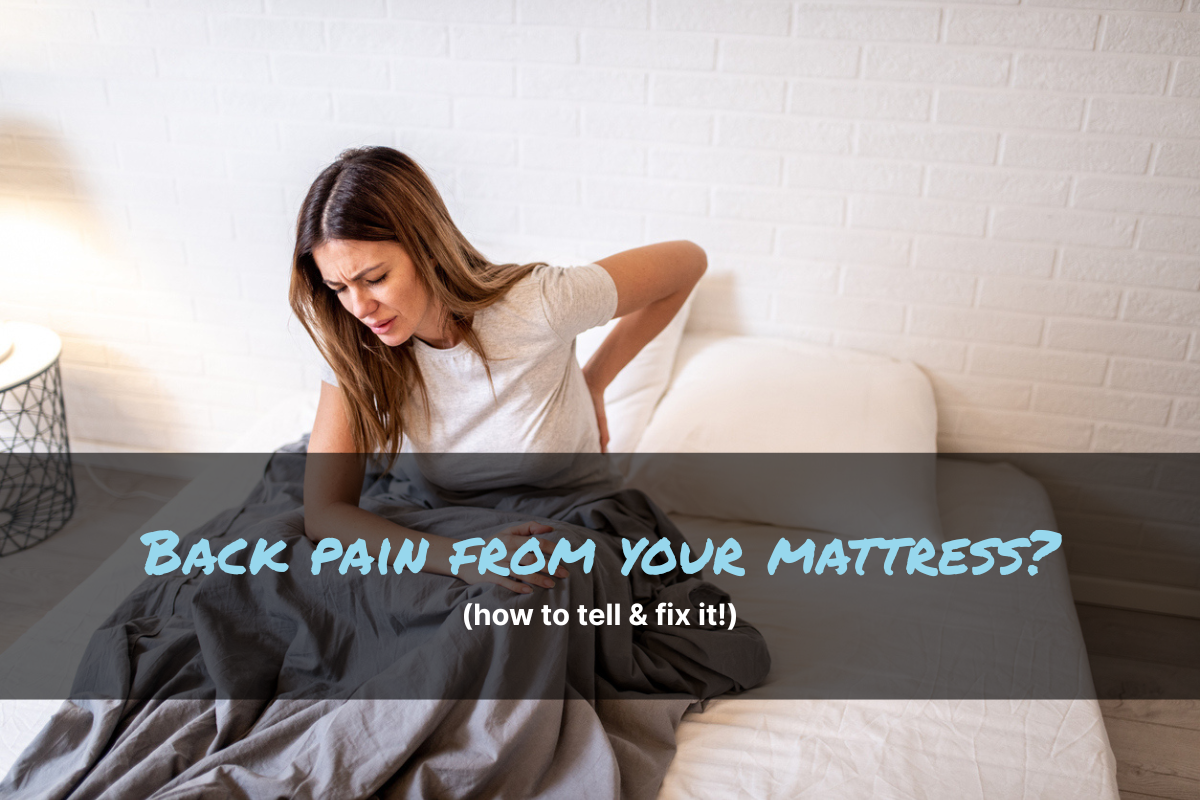
Is Your Mattress Causing Back Pain? How to Tell & Fix It

KARL'S QUICK OPINION: After 15 years of making mattresses and helping thousands of people solve their back pain issues, I can tell you this: about 60% of mattress back pain comes from a spring tension to body weight mismatch. Your mattress hurts your back because the springs are either too firm for your weight (causing pressure points) or too soft (creating a hammocking effect). The "firm is best for back pain" myth is rubbish—what matters is the right fit for your body weight and sleeping position. The best mattress for back pain maintains proper spinal alignment while providing adequate support and pressure relief.

The back pain epidemic: why it's so common

Back pain is the leading cause of disability worldwide, and it's costing Australians billions in healthcare and lost productivity each year. But here's what most people don't realise: whilst we often blame our office chairs, poor posture, or heavy lifting, we're spending 7-9 hours every single night on a surface that could be doing more damage than anything else in our day.

Think about it: one-third of your life is spent in bed. If your mattress isn't properly supporting your spine for those 8 hours, you're essentially spending a third of your existence in a position that's working against your body's natural alignment. That's 2,920 hours per year of potential damage.

Research from 2025 shows that 70% of people experience better sleep quality after getting a new mattress, and studies confirm that medium to medium-firm mattresses are most suitable for back pain relief. However, the reality is more nuanced than simply choosing "medium firm"—it's about matching the supportive mattress to your specific body weight and sleeping position.

Understanding your back pain symptoms: a diagnostic guide

Let me walk you through the most common types of back pain and what they're telling you about your mattress.

1. Lower back pain when you wake up

What it means: Your mattress is likely too soft for your body weight, or your bed base has failed.

When you wake up with lower back pain that wasn't there before bed, it's usually because your body is "hammocking" into the mattress. Your hips are sinking too far whilst your shoulders remain higher, causing your spine to curve unnaturally throughout the night. This is textbook "lack of support."

The fix:

  1. Check your base first. Put your mattress on the floor. Feel better? Your slats are the problem. Replace flexible slats with solid slats or use a platform base.

  2. If the base is fine, you need firmer springs matched to your body weight. At Ausbeds, we use:

    • Soft springs for people under 70kg

    • Medium springs for 70-102kg

    • Firm springs for 102-127kg

    • Extra firm for over 127kg

Getting this right is 60% of solving back pain from your mattress.

2. Hip and shoulder pain (pressure points)

What it means: Your mattress is too firm for your body weight, or the supportive coil system isn't contouring properly to provide good pressure relief.

When you wake up with painful hips or shoulders, you're getting too much pressure concentrated in these areas—classic pressure points that need alleviating pressure points through better support.

Think of that marshmallow on a table again. Your hip is pushing through the soft layers and landing on top of the springs. The pressure comes from incorrect pressure distribution—your hips have moved through the comfort layers and landed on top of the spring.

The fix:

What we need to do is "soften the table." You need the right springs that will contour around your hips, providing pressure relief and distributing pressure all the way around your hip area.

The foam on top (latex, polyfoam, or memory foam) will make a small difference, but if the springs aren't right for your body weight, it won't matter. I think latex is the best foam, but if you put it on the wrong spring for your body weight, it's not going to help.

For side sleepers especially, you need what's called "point elasticity"—the ability for the mattress to absorb your shoulders and hips whilst still pushing your torso up. This is the holy grail for a mattress for back pain, but also very difficult to achieve without proper spring design.

3. Mid-back or upper back stiffness

What it means: Poor spinal alignment from an ill-fitting mattress.

If you're waking up with stiffness through your mid or upper back, your spine isn't staying in a neutral position throughout the night. Your body is either too supported in some areas and not enough in others, forcing your spine to maintain an unnatural curve.

The fix:

Lie down on your mattress and close your eyes. Focus on how it feels. We're trying to divert pressure away from your pressure points to avoid contorting your spine. Is it pressing against your bottom? Too firm. Do you feel like you're sinking? Too soft. A neutral feel is what you're aiming for.

If you feel pressure on your bottom or shoulders, you need softer springs or more contouring comfort layers. If you feel like you're sinking with no support, you need firmer springs matched to your body weight.

4. Neck pain and headaches

What it means: Often a pillow issue, but your mattress plays a role too.

While neck pain is usually about your pillow, your mattress contributes. If your mattress is too soft and your body sinks in, your head sits at an odd angle all night. If it's too firm, your shoulders can't sink in properly, again throwing your neck alignment off.

The fix:

  1. Sort your mattress alignment first using the guidelines above

  2. Then adjust your pillow height to match—if you're a side sleeper on a properly fitted mattress, you need enough pillow to fill the gap between your shoulder and head

How your mattress creates back pain: the real culprits

Problem 1: The wrong spring tension for your body weight

This is the most critical factor, and it's something almost nobody talks about. I've been matching spring tension to body weight for over a decade, and I can tell you with certainty: about 60% of mattress problems come from having a spring tension to body weight mismatch.

Here's what happens:

If you're too light for your springs (springs are too firm for your body weight), your body won't sink into the mattress properly. Instead of the springs yielding to your body, your body yields to the springs. This causes your spine to contort and stretch during the night, leading to pressure points on your hips and shoulders. Side sleepers especially struggle with this—you need the mattress to cushion shoulders and hips whilst pushing your torso up. Without proper point elasticity, you'll wake up with pain.

If you're too heavy for your springs (springs are too soft for your body weight), you'll experience what I call a "hammocking effect." Your body falls too deeply into the mattress, and your spine curves out of its neutral position. This is what people usually mean when they say a mattress "lacks support." Your lower back curves unnaturally for 8 hours straight, and you wake up in pain.

Let me give you a real-world example. A 50kg person will find the vast majority of mattresses "too firm," whilst a 120kg person will find most mattresses "too soft." These two weight ranges will sink to very different depths into the same mattress. Gravity and body weight. That same mattress will feel completely different to each person.

A firm mattress for the 50kg person creates painful pressure points. A soft mattress for the 120kg person provides inadequate support. Neither gets proper spinal alignment or quality sleep.

Problem 2: Incorrect pressure distribution and pressure points

I use this analogy with customers: think of a marshmallow on a table. You push through the layers—it's soft on top—but then your finger hits the table, and it's firm. If you push hard enough for long enough, your fingertip will hurt because it's getting a disproportionate amount of pressure.

Your hip is the same as that fingertip. When the comfort layers aren't thick enough or the springs underneath are too firm for your body weight, your hips push through the soft layers and land directly on top of the springs. That concentrated pressure on your hips forces your spine out of alignment, creating lower back pain.

The solution isn't just adding more memory foam on top. Memory foam comfort layer additions help, but you need to "soften the table"—which means getting the right spring tension for your body weight so the springs themselves contour around your hips, providing pressure relief and distributing pressure all the way around.

For back sleepers, pressure points typically develop in the lower back if the mattress doesn't maintain the spine's natural alignment. For side sleepers, it's the shoulders and hips. Stomach sleepers need just enough cushioning to keep their hips from sinking, whilst maintaining a neutral position for their spine.

Problem 3: Sagging and dipping mattresses

I pull apart failing mattresses every week, and I can tell you exactly what's happening. In 99% of cases, it's the plastic foam that deteriorates, not the springs. The foam layers lose their resilience, creating a dip where your body rests. Once you're sleeping in a dip, your spine is curved unnaturally for 8 hours straight.

There are three types of dipping I see:

Type 1: Foam degradation – All plastic-based foams (polyfoam and memory foam) will lose resilience over time. The lower the density, the faster it happens. I've seen people spend $4,000+ and have a dipped entire mattress within six months because the foam was low quality.

From my experience pulling apart hundreds of mattresses:

Foam Type

Foam Degradation

Low-density polyfoam

1 year until noticeable sagging

Medium-density polyfoam

4 years

High-density polyfoam

7 years maximum

High-density memory foam

6 years maximum

Natural latex

I haven't witnessed a dipped piece yet

This is why I only use natural latex in my mattresses. It lasts 3-4 times longer than polyfoam, doesn't trap heat like memory foam, and maintains consistent support throughout the life of the mattress.

Type 2: Wrong spring firmness – If the springs are too soft for your body weight, you start falling into the mattress more than intended. The upper layers "stretch" into the bottom support layers. Eventually, this creates a permanent dip. Sometimes people think a mattress is sagging when it's actually a spring tension to body weight mismatch. We simply swap the spring unit for a firmer one, and they're happy.

Type 3: Concentrated sitting – If you sit on the edge of your bed regularly (reading, putting on shoes), you're concentrating all your body weight in one spot. Mattress foams are designed for laying down, not sitting. This accelerates wear in that specific area and reduces edge support. A mattress with solid edge support and a supportive coil system will handle this better, but it's still not ideal.

Problem 4: Bad bed bases (the hidden culprit)

This happens ALL THE TIME, and people blame their mattress when it's actually the base causing the problem. Here's a quick test: put your mattress directly on the floor. Does it feel better? Then your slats are rubbish.

Why does this happen? Engineered wood slats are MUCH cheaper than pine slats, so manufacturers use them to increase profit. Engineered wood can be made of absolute trash and flexes where you lay. The more it flexes, the softer your mattress becomes.

Quite often, your mattress isn't sagging—it's your base. If you get a new mattress without fixing the base, it won't be long before the new mattress does the same thing.

The best mattress foundation is a dead flat concrete slab. Get as close to that as possible with solid pine slats without knots (knots cause breaks). This provides the proper support that allows your mattress to maintain spinal alignment.

Close-up photo of a mattress corner showing detailed quilting and layered side panels in beige and brown tones. A small black fabric label with white text reading “FIRM” is attached to the mattress border, indicating its firmness level.
mattress closeup with the label "firm"

Mattress firmness myth: "Firm is best for back pain" debunked

This isn't true, and it's one of the most damaging myths in the mattress industry. The truth is, there are a few very important things at play when you're fitting to a mattress: gravity and your body weight.

If you have a bad back and ask me what's the best mattress for back pain, I tell you the same thing I tell everyone: the one that fits. Then I fit you to something that keeps your spine aligned with no pressure points.

A poorly suited mattress that's too firm will usually do the opposite. Having your spine at the edges of its movement range is why people have bad sleep and wake up pain-free no more. Some back problems—like slipped discs—can require an extremely firm mattress to prevent the vertebrae from squashing the swollen discs. But usually, you need a mattress that maintains your spine's natural curve whilst distributing pressure away from your hips and shoulders.

The research backs this up. A 2025 study on mattress firmness and sleep architecture found that soft mattresses resulted in significantly longer sleep latency and more frequent transitions to lighter sleep stages compared to medium mattresses. The researchers concluded that inadequate support and poor spinal alignment from overly soft mattresses impaired sleep onset and maintenance.

However, studies also show that very hard mattresses produce the poorest sleep quality. The sweet spot for most back pain sufferers is a medium-firm mattress or a mattress customised to their specific body weight—not "firm" across the board.

Back pain relief: the Ausbeds approach

I believe there's a scale of how important it is to get the right mattress. Young, light, physically active, fit and healthy people are at one end of the spectrum—the lowest risk group who can pretty much sleep on anything. Older, higher body weight ranges, low mobility, and back problems are at the other end, requiring a lot of care to get the fit exactly right.

These are the people I spend the most time helping, because getting it right is going to make a huge difference to their quality of sleep and back pain relief.

Step 1: Match spring tension to body weight

This should be 100% of the initial focus. Here's my general guide:

  • Under 70kg: Soft spring tension

  • 70-102kg: Medium spring tension

  • 102-127kg: Firm spring tension

  • Above 127kg: Extra firm spring tension

At Ausbeds, we use 7-turn pocket springs in a honeycomb arrangement with 1,160 springs in a king mattress. Most mattresses have around 870 springs, which isn't enough for proper pressure distribution and motion isolation.

The springs decide your body shape and proper spinal alignment. The foam layers on top change the feel. If you get the right spring tension, your body will be in the right position, and it's less important what padding you use for the sleep surface.

Step 2: Choose the right comfort materials

Once the springs are sorted, you need enough cushioning so you don't feel the springs themselves and you get proper pressure relief. I recommend:

For back pain sufferers and pain relief:

  • Minimum 5cm of comfort material so you don't feel the springs

  • Natural latex is my top choice—it lasts 3-4 times longer than polyfoam, doesn't trap heat like memory foam, and provides excellent pressure relief

  • Micro springs under the latex (like in our Aurora and Cloud mattresses) add contouring without heat retention and improve motion isolation

The ideal mattress for side and back sleepers combines responsive latex with properly tensioned springs. Back and stomach sleepers typically need less cushioning—around 5-7.5cm—to maintain proper support and spinal alignment. Stomach sleepers especially need a supportive mattress that prevents their hips from sinking.

Step 3: Check and fix your bed base

This is often overlooked but absolutely critical for proper support and back pain relief.

Red flags:

  • Flexible engineered wood slats that bow under your weight

  • Gaps wider than 7cm between slats

  • Slats with knots or cracks

  • Old bed frames with sagging centre support

The solution:

  • Replace with solid pine slats (no knots)

  • Keep slat spacing at 7cm or less

  • Use a platform base for dead flat support

  • If your mattress feels better on the floor, your base is definitely the problem

I've had customers spend thousands on a new mattress only to put it on a rubbish base. Within months, they're back to square one. Don't make this mistake.

Step 4: Consider your sleeping position and sleep style

Different sleeping positions require different levels of support:

Side sleepers (the majority):

  • Need more contouring for shoulders and hips

  • Benefit from softer to medium firm support

  • Require point elasticity to cushion shoulders whilst supporting the torso

  • The mattress should relieve pressure on the hips and shoulders whilst keeping the spine aligned

Back sleepers:

  • Need support that maintains the spine's natural alignment

  • Usually prefer medium firm to firm support

  • Require adequate support under the lumbar region

  • Should avoid anything too soft that allows hammocking

Stomach sleepers:

  • Need firmer support to prevent hip sinking

  • Require minimal cushioning to maintain a neutral position

  • Risk lower back strain if the mattress is too soft

  • Should avoid plush pillow top mattresses

Combination sleepers:

  • Need a balanced hybrid mattress that works across positions

  • Benefit from responsive materials like latex that adjust quickly

  • Require good edge support for position changes

  • Usually prefer medium firm support

Step 5: Test for proper alignment

Here's how to check if your mattress is providing proper spinal alignment:

  1. Lie down in your normal sleeping position

  2. Close your eyes and focus on the feel

  3. Ask yourself these questions:

    • Do I feel pressure on my hips or shoulders? (Too firm)

    • Do I feel like I'm sinking into the mattress? (Too soft)

    • Does my lower back feel supported or strained? (Alignment issue)

    • Can I maintain a neutral position comfortably? (Ideal)

A neutral feel is what you're aiming for. Not pressing against your bottom (too firm), not sinking excessively (too soft)—just neutral support that lets your body relax into the body's natural alignment.

What type of mattress to avoid for back pain

Based on 15 years of experience and countless failed mattresses I've examined, here's what to avoid:

1. One-size-fits-all "bed-in-a-box" mattresses

These mattresses come in one firmness for everyone. A 60kg person and a 110kg person get the exact same springs. This is a poorly suited mattress approach that ignores the fundamental reality: body weight determines how you'll experience firmness.

The marketing is clever, but the engineering is lazy. You might get lucky, but more likely you'll end up with a mattress that's wrong for your weight.

2. Ultra-plush pillow top mattresses (unless you're very light)

Thick, soft pillow tops feel amazing in the showroom for 5 minutes. After 8 hours? Your spine is curved unnaturally, and you wake up in pain. Unless you're under 60kg, avoid these for back pain.

The exception is if you need the pillow top for pressure relief but have firm springs underneath matched to your weight. That can work. But most plush pillow top mattresses have soft springs AND thick soft padding—a recipe for hammocking.

3. Low-density foam mattresses (including memory foam)

All-foam mattresses with low-density polyfoam or memory foam will sag within 1-2 years. Once they sag, your proper spinal alignment is gone, and back pain returns.

High-density memory foam lasts longer (5-6 years), but it still can't match latex for durability and pressure relief. Memory foam also tends to trap heat, which disrupts sleep quality and can cause you to move more during the night, potentially worsening back pain.

4. Super firm "orthopaedic" mattresses (unless specifically prescribed)

The myth that "firm is best" leads people to buy rock-hard mattresses that create pressure points and poor spinal alignment. Unless you have a specific condition (like a slipped disc) that requires extreme firmness, these mattresses usually make back pain worse, not better.

5. Mattresses with inadequate spring count

A king mattress needs at least 1,000-1,200 pocket springs for proper pressure distribution and support. Many budget mattresses have 600-800 springs, which means larger gaps between springs and poorer contouring. This leads to pressure points and inadequate support.

The supportive coil system is the foundation of a hybrid mattress. Skimp here, and no amount of foam on top will fix the problem.

The best mattress for back pain: key features to look for

If you're shopping for a new mattress to solve back pain, focus on these features:

1. Customisable spring tension

The ability to match spring firmness to your body weight is non-negotiable for back pain sufferers. This is why we built Ausbeds mattresses to be completely modular—you can swap spring units as your weight changes or if your initial selection isn't quite right.

2. Natural latex comfort layers

Natural latex provides the best balance of pressure relief, durability, and temperature regulation. It doesn't trap heat like memory foam, lasts 3-4 times longer than polyfoam, and provides excellent pressure relief without allowing excessive sinking.

The best mattress for back pain combines latex comfort layers with properly tensioned pocket springs.

3. Good motion isolation

If you share your bed, motion isolation prevents your partner's movements from disturbing your sleep. Poor sleep quality exacerbates back pain, so this feature matters more than you might think.

Pocket springs provide better motion isolation than traditional bonnell springs. Adding a latex or memory foam comfort layer improves motion isolation even further.

4. Breathability and temperature regulation

A mattress that can trap heat disrupts sleep quality. Memory foam is the worst offender—it absorbs and holds body heat, causing night sweats and restless sleep. Poor restorative sleep means less pain relief and more morning stiffness.

Natural latex breathes naturally, whilst micro springs (like in our Aurora hybrid mattress) create air channels that improve circulation. Look for breathable materials if you want a better night's sleep and better pain management.

5. Adjustability

The best mattress allows for adjustments after purchase. At Ausbeds, we include a felt layer under the springs that can be moved on top for a firmer feel. We can swap springs if needed. We can change the latex thickness.

Why? Because what feels right in a 10-minute showroom test might not be perfect after a week of sleep. Bodies are different. Having options means you're not stuck with a $3,000 mistake.

Need help finding your bad back's match?

Explore our body weight-matched mattresses to get the proper support for YOU.

Shop mattresses

Conclusion: your back pain might be an engineering problem

Back pain is the most common pain problem because we spend a third of our lives on surfaces that either don't support us properly or actively harm our spinal alignment. Your mattress creates back pain through:

  1. Wrong spring tension for your body weight (60% of the problem)

  2. Poor pressure distribution creates pressure points

  3. Sagging foam layers that destroy spinal alignment

  4. Faulty bed bases with flexible slats

  5. Myths about firmness leading to poorly suited mattress choices

The fix isn't complicated, but it requires understanding that one size does not fit all. The best mattress for a 60kg person won't work for a 100kg person. The mattress that feels "supportive" to one person feels like concrete to another. The mattress for back pain that works for back sleepers may be wrong for side sleepers.

At Ausbeds in Marrickville, we've spent over a decade refining a system that matches spring tension to body weight, uses materials that don't deteriorate (natural latex), and allows for endless adjustability because we know that getting it right the first time in a showroom is nearly impossible.

If you're waking up with back pain, don't assume it's just your age, your job, or "how you slept." Take a hard look at your mattress and your base. Put your mattress on the floor and see if the pain improves—if it does, your base is the problem. If it doesn't, your mattress probably has the wrong spring tension for your weight, sagging foam, or both.

Your back pain might not be a medical problem. It might just be an engineering problem with a straightforward solution: the right mattress with proper support, pressure relief, and spinal alignment for YOUR body.

The path to pain-free mornings and a restful night's sleep starts with understanding what your mattress is doing to your back—and fixing it.

Frequently asked questions about mattress back pain

About the author

Karl from Ausbeds

Karl is the owner of Ausbeds. He started the company after realising how many people were frustrated by mattresses that failed too soon and too often. So he built a workshop in Sydney and began making mattresses the way they should be made - with transparent materials, adjustable designs, and customer-first thinking. When he's not in the showroom/workshop, he's on Reddit, Whirlpool, and OzBargain, cutting through industry fluff with honest mattress advice.

You might also like