Body Weight and Mattresses: The Number One Thing That Matters
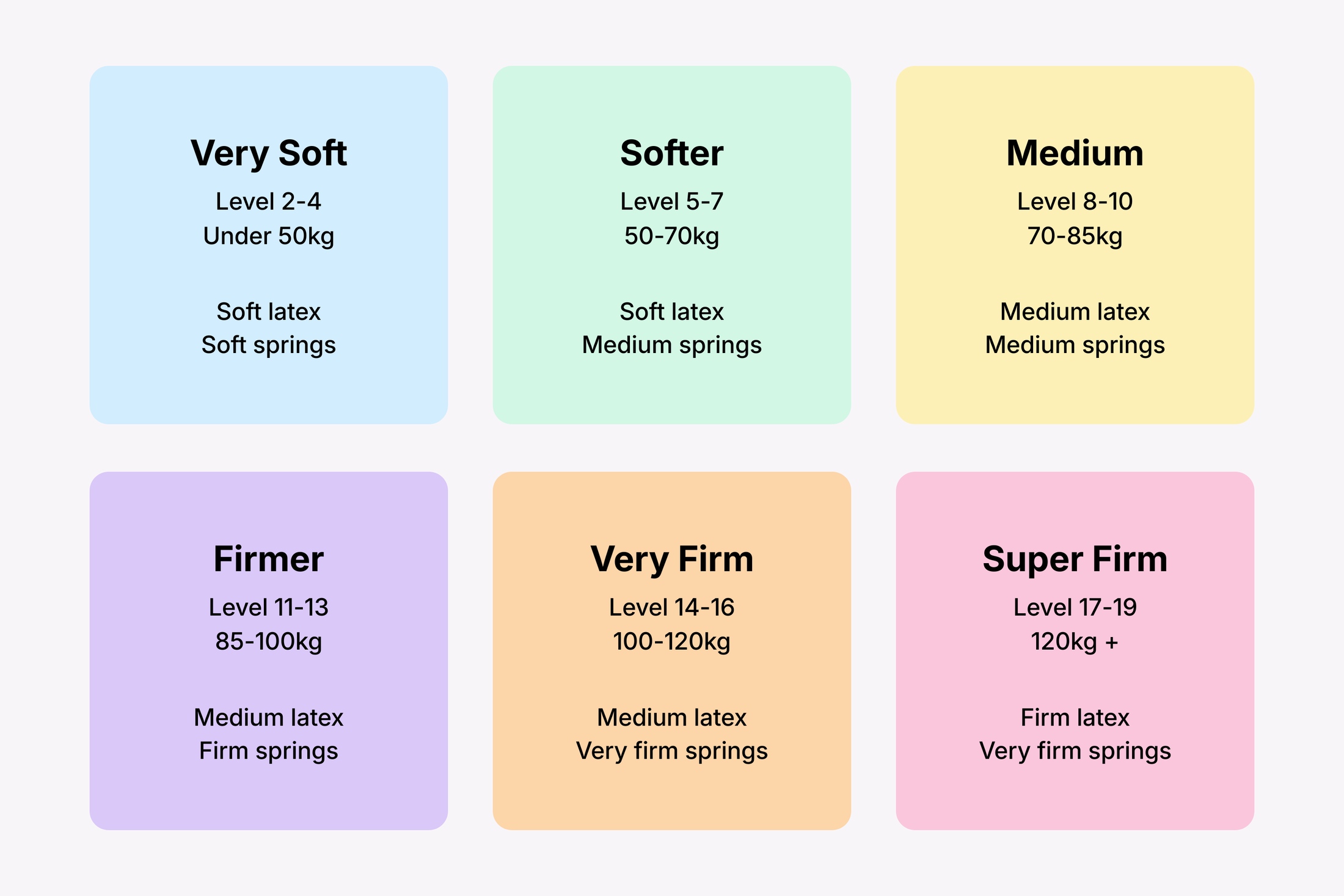
Why spring tension matters the most
Your weight changes everything about how a mattress feels. The same mattress feels completely different to a 60 kg person versus a 100 kg person. This isn't about preference. It's physics. Body types vary, and so do the needs of different body types.
-
When you're too light for the springs: The springs won't yield to your body. Instead, your body yields to the springs. You'll feel pressure points on your shoulders and hips. You'll wake up stiff and sore because your body spent the night contorted, trying to match the unyielding sleep surface underneath. This often happens to lightweight sleepers on firm mattresses.
-
When you're too heavy for the springs: You sink too far into the mattress. Your hips drop down, your spine curves unnaturally, and you get that "sleeping in a hole" sensation. This is the textbook definition of "lack of support" - your body falls out of proper spinal alignment. This is a common issue for heavier sleepers on a soft mattress or medium soft option, not designed to support larger bodies.
-
When spring tension suits the latex choice and your weight:Your body maintains its natural curve. Weight distribution is even across the sleep surface. Your shoulders and hips sink just enough. Your middle torso gets proper support. You wake up in the same sleeping position you fell asleep in because you weren't tossing around looking for comfort. This provides the best support and pressure relief.
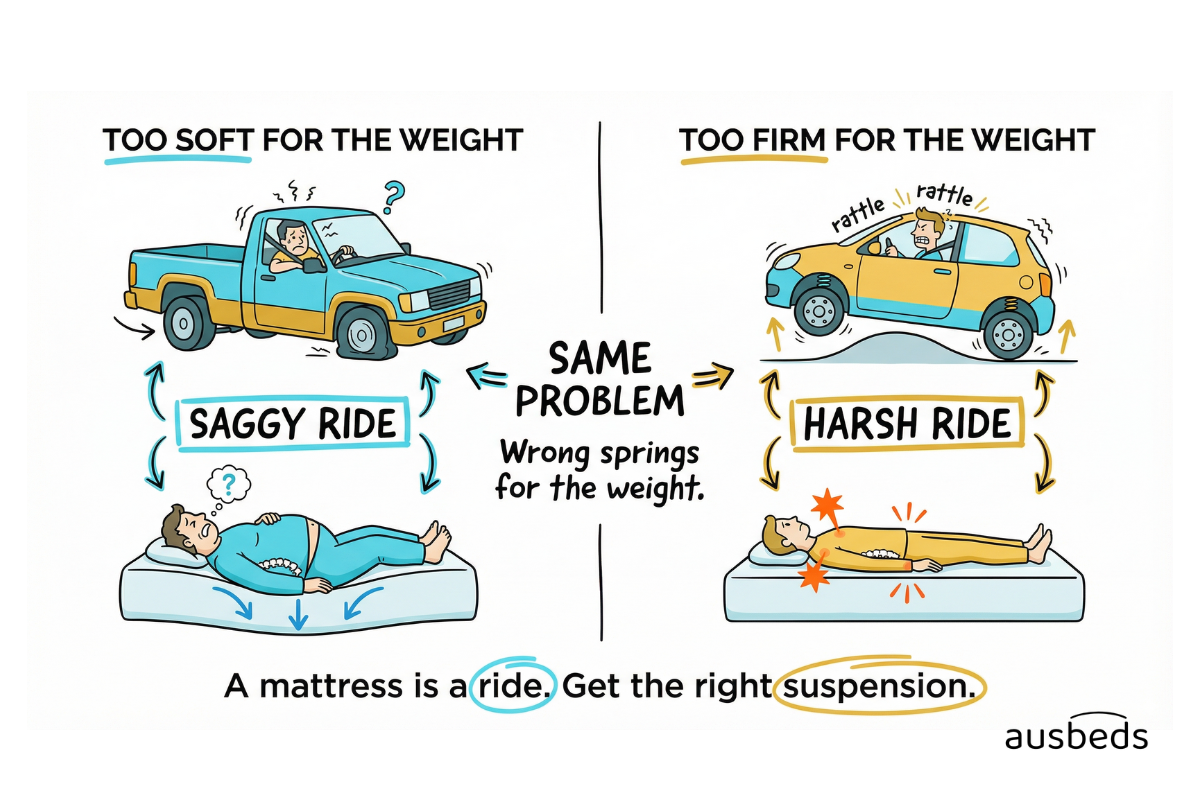
What is "enough support?": the car suspension analogy
Think of a car suspension. You wouldn't put heavy truck suspensions into a hatchback. The ride would be terrible. That's exactly what happens with mattresses. Heavier sleepers generally need more spring support, but the threshold depends on the latex surface. With soft latex, firm springs start at 80kg. With medium latex, they start at 100kg. Medium springs are standard below those thresholds. Soft springs are request-only for children and people under 50kg because they are too soft for most adults. Sometimes there is nothing wrong with the mattress quality; the components are simply a poor match. A mattress is a suspension system for your body; a "ride." Great support = great ride.
Julie's Story: 30 years of sleeping on the wrong mattress springs
Here's a true customer story. Julie is a lightweight person. For 30 years, she went to mattress stores where salespeople weren't aware that different body weights require different spring tensions. They weren't installing bad springs - they were installing the WRONG springs for her lighter frame. She researched online and bought "the best mattress in Australia" from a top-ten list. It was extremely uncomfortable. Then she found a mattress manufacturer (Karl) who said, "You're lightweight, and you've got springs designed for a much heavier person. Let's sort that out".
We changed the setup to suit her surface feel and body weight. Suddenly, she felt like she was floating. All of Julie's previous mattresses may have been high quality. But quality doesn't matter if the springs are too firm for your weight.
"I am fairly light in weight and for the past 30 years or so as I have aged, I have never found a bed that was comfortable, or that didn't hurt my shoulders, hips or back... Most importantly, my bed doesn't cause me any pain". - Julie D., Melbourne
How we match springs to latex choice and body weight
First choose the surface feel: soft latex for a plush feel or medium latex for a balanced, responsive feel. We then use your latex choice and body weight to select the support underneath.
| Surface feel | Medium springs | Firm springs |
|---|---|---|
| Soft latex | Under 80kg | 80kg and over |
| Medium latex | Under 100kg | 100kg and over |
Soft springs are available by request for children and people under 50kg, but they are too soft for most adults. Contact us for a quote. If you weigh more than 130kg, contact us so we can check the complete setup.
Soft latex is only available with the Cloud’s 2 micro spring layers.
Firm latex is also available by request, but it is far too firm for most applications and can cause pressure pain. Firm springs with medium latex usually provide a better balance of firm support and cushioning.
Why most companies don’t do this
The problem is logistics. Even medium and firm support across 5 mattress sizes creates more product variations than a one-size-fits-all spring unit. That's operational complexity most companies won't deal with. They'd rather make one "universal" mattress and hope it works for everyone. The mattress industry average refund rate hovers around 10-20%.
Why do we know this works?
The results speak for themselves. After implementing systematic body weight matching:
-
Refund rate dropped below standard industry levels
-
80% success rate with the initial latex-and-weight recommendation
-
20% require individual fine-tuning beyond the starting recommendation
What this system fixes (that nothing else can)
Heat retention
When spring tension is correct, your body sits at the right height in the mattress. You don't need excessive foam to compensate for a wrong spring. Less foam, less heat trapped. Too many mattresses use very firm springs (manufacturers think this prevents sagging), then pile on thick foam layers to make them comfortable. That creates an oven.
Premature sagging
When springs are too firm for your weight, the foam gets crushed between your body and the unyielding spring tops. This speeds up foam deterioration dramatically. When spring tension matches the latex choice and body weight, the spring absorbs its share of the load. The foam lasts years longer because it's not taking all the punishment.
Pressure points and pain
The ultimate goal: distribute pressure away from the hips and shoulders, move it into the middle torso. This allows your body to maintain its natural curve. Correct spring tension for the latex choice and body weight helps achieve this goal. Wrong spring tension makes it impossible, regardless of what foam you put on top. The springs decide your body shape. The foam just changes how it feels.
What if my sleeping partner weighs much more/less than me?
Couples with different weights
For couples, we use the heavier person’s weight for the standard spring recommendation. Firm springs with soft latex are often the best shared starting point when weights or preferences differ: the springs support the heavier person while the latex keeps the surface plush for the lighter person.
We no longer put two spring systems inside one mattress. If one side needs to feel firmer, we can use half-width felt. For very different needs, two King Singles may be the better option.
What about spring count, materials, and other specs?
Do they matter?
Yes. But only if you get spring tension right first. Our innerspring mattresses' construction includes 986 honeycomb pocket springs (Queen) vs the industry's typical. Having 986 well-made springs does not help if they are the wrong tension for the latex choice and body weight.
What about the foam?
If you have the right mattress firmness from the springs, you can choose foam based purely on preference:
-
Polyfoam: Most affordable, works great when springs are correct
-
Memory foam: Adds motion isolation, sleeps warmer
-
Natural latex (Aurora and Cloud): Durable, responsive and less heat-retentive than memory foam
The springs hold your body in proper spinal alignment. The foam determines how it feels getting there.
Sleeping position: Does being a back/ stomach sleeper or side sleeper make a difference?
Yes, but it helps choose cushioning after the latex feel and spring support are selected.
Stomach sleepers
When you sleep on your stomach, there are no shoulders or hips that need to be absorbed into the mattress. Also, when you are on your front, if your stomach drops into the mattress, it can overarch your back, causing some pain in the small of your back. Stomach sleepers usually prefer the Aurora with 1 micro spring layer for a flatter, more direct surface. The main spring recommendation still comes from latex choice and body weight.
Side sleepers
You are in the category of someone who would greatly benefit from trying as many mattresses as possible. On your side, you will feel a lot of pressure on the hips and shoulders if you get a slab [that's too firm].
Heavy side sleepers (110kg+ example):
One customer asked, "I'm quite heavy (110kg) and around 185cm. I am a side sleeper and sometimes sleep on my stomach. " For heavier people, I use firm springs, but I also make sure the top has enough cushioning. Heavier sleepers will have a more challenging time with comfort because there is more weight to be distributed.
The only way I have been able to reduce the pressure for someone at a higher bodyweight is to make sure the spring tension is high enough, by increasing the wire thickness, and then adding extra cushioning on top. I use more microsprings and latex. One of the problems is right here. I increase the spring tension, so the spine is aligned. The customer may now be aligned, or not sinking in, and then they may say, "Now I feel too much pressure". What's happening is the springs are doing their job, but the pressure is now concentrated on the hips and shoulders. And it feels too firm. The only way I see around this is to add more microsprings and latex (cushioning). This distributes pressure away from the pressure points.
Combination sleepers:
Standard recommendations work for approximately 80% of customers with typical body composition, mixed or side sleeping positions, no significant health conditions affecting sleep, and average firmness preferences. People who have found the perfect mattress spring tension
Real customers who have found the perfect mattress spring tension
After 50+ years of premium mattresses
"Getting the right spring rate for body weight is essential, but few other mattress manufacturers seem to realise this... The result is the first truly satisfactory mattress we have experienced in 50+ years... We have bought many premium mattresses over the years, and this is the first one ever that hasn't been a disappointment". - Tony M.
Very different weights, both with back pain
"My partner and I are very different weights, and have been looking for a bed that would suit both of our needs, especially since we both also suffer from back pain... We ended up choosing the Cloud range, in a firm mattress and medium firm half/half... Our back pain has reduced noticeably, the different mattress types are not a gimmick, and you can feel the differences in each of our sides". - Nick Jones, Sydney
Ready to choose your starting configuration?
- Choose soft latex for a plush surface or medium latex for a balanced, responsive surface.
- Use your latex choice and body weight to select medium or firm springs.
- Choose 2 micro spring layers for more cushioning or 1 for a more direct surface.
- Test the mattress, use the at-home felt and spring adjustments if needed, and contact us for a larger component change.
What you get:
- 7-month trial period
- 2 free firmness swaps
- 10-year warranty
The starting recommendation is based on the latex choice and body weight, but the mattress remains adjustable if the first setup is not quite right.
FAQ: Body weight-matched mattresses
About the author

Karl is the owner of Ausbeds. He started the company after realising how many people were frustrated by mattresses that failed too soon and too often. So he built a workshop in Sydney and began making mattresses the way they should be made - with transparent materials, adjustable designs, and customer-first thinking. When he's not in the showroom/workshop, he's on Reddit, Whirlpool, and OzBargain, cutting through industry fluff with honest mattress advice.