Mattress Recommendations – How we match you to the right mattress
How accurate is our mattress recommendation?
A swap is the most honest signal we get about whether we recommended the right mattress. It is a customer telling us, "This firmness isn't quite right; I need to go firmer or softer." So when the swap rate drops, it means we're getting people closer to the right mattress the first time.
Since we launched the recommendation system in early 2026, swap rates have dropped from about 7% to under 2%. That means we have reduced incorrect firmness choices by over 70 per cent compared to our old process.
Need a recommendation?
Choose the surface feel and cushioning you enjoy, and we'll match the support underneath.
How it works
When you buy a mattress through our recommender, we securely log your initial recommendation alongside the final mattress you chose. If you swap during your trial, we can see if you need to go firmer or softer. All data is anonymised. We watch the trends and adjust our recommendations. It's a system that's given us proven, measurable results.
Swaps, feedback and returns – we use these analytics to constantly refine our recommendations.
The recommendation variables
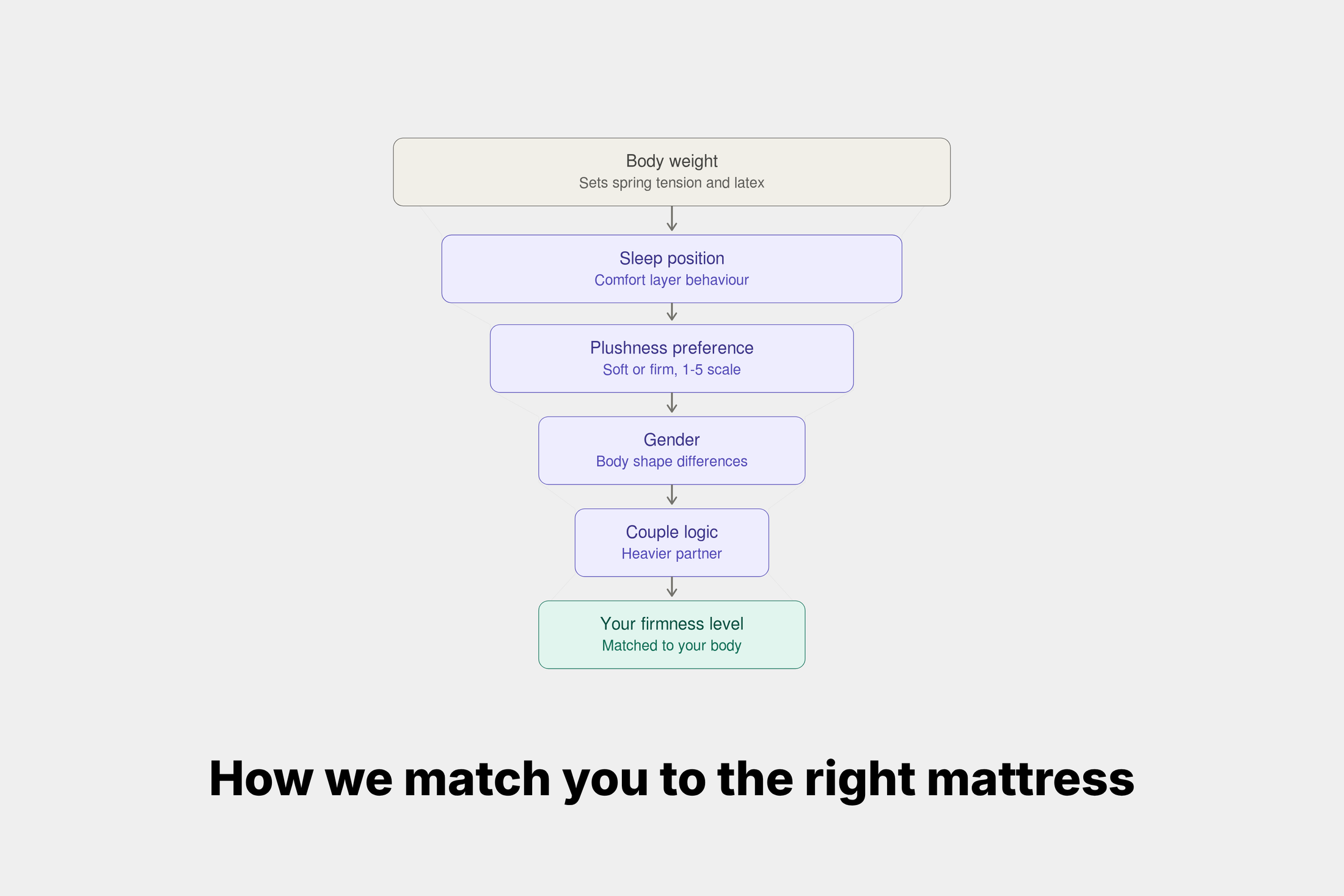
We start with your body weight and then adjust for four variables:
- Sleep position: Side sleepers need more shoulder and hip cushioning with greater point elasticity; stomach sleepers need flatter, firmer support
- Plushness preference: How soft or firm you like things, on a 1–5 scale
- Gender: Different body shapes. Women tend to be curvier and prefer slightly more sink and plushness.
- Couple logic: We use the heavier partner's firmness as the baseline and slightly bias the model choice towards whoever prefers more cushion.
Body weight sets the spring tension and latex density
Your body weight determines which spring tension and latex firmness you receive.
| Body weight | Firmness range | Springs | Latex | Default level | Range |
|---|---|---|---|---|---|
| Under 50kg | Very Soft | Softer | Soft | 3 | 2–4 |
| 50–70kg | Softer | Medium | Soft | 6 | 5–7 |
| 70–90kg | Medium | Medium | Medium | 9 | 8–10 |
| 90–110kg | Firmer | Firmer | Medium | 12 | 11–13 |
| 110–130kg | Very Firm | Firmer | Firm | 15 | 14–16 |
| Over 130kg | Super Firm | Very Firm | Firm | 18 | 17-19 |
How sleep position changes the recommendation
Body weight tells us what spring tension you need. Sleep position tells us how those springs and comfort layers need to behave under your body.
Side sleepers need balanced springs with more sink in the comfort layers. When you sleep on your side, your shoulders and hips are the main contact points. They need to sink into the mattress while the surrounding areas stay supported. The springs play a direct role in contouring the body so the spine stays straight. More point elasticity means the mattress wraps around you rather than pushing back. This is why side sleepers tend to prefer models with micro springs. The cushioning lets shoulders and hips drop in without compromising spinal alignment.
Back sleepers and stomach sleepers generally need firmer springs to maintain spinal alignment. Too soft, and people with heavy shoulders or a heavier pelvis will sink, causing neck or back issues. There are exceptions, however. People with curvier body shapes, or spinal conditions like lordosis and kyphosis, often need a slightly softer feel. That extra cushion is necessary to properly support deeper spinal curves and wider hips.
This is the part most mattress websites get wrong. They treat sleep position as a simple formula: "side sleepers = soft, stomach sleepers = firm." But a 55kg side sleeper and a 110kg side sleeper that both sleep on their side need completely different spring tension and different comfort layer behaviour.
How sleep position maps to model choice
Once we know your firmness range, your sleeping position guides which model to start with.
Side sleepers gravitate towards the Cloud (3,200 micro springs on a queen) or Aurora – the micro springs let shoulders and hips sink in for pressure relief without compromising support.
Back sleepers usually do well on the Cooper or Aurora at their default level. Body weight is distributed more evenly, so there's less need for extra cushioning.
Stomach and back sleepers often prefer the Cooper at their recommended firmness or one level firmer – a direct, responsive feel with no sink.
How we recommend to couples
For couples, the heavier partner determines the firmness. If you're within 40kg of each other, a standard mattress works. The lighter partner still gets comfort and pressure relief from the micro springs.
For couples with a 40kg+ weight difference, our recommendation is to buy two king singles and push them together or find a compromise. We used to make half-half mattresses, where each person got different springs, but it was difficult to get them right. Come into the showroom or call us up. Most of the time, couples choose a standard mattress once we talk through weights and preferences.
Where you might want personalised advice
There are three situations where it's better to call us:
-
Anyone over 130kg: Body shape and existing pain can outweigh body weight as the primary factor.
-
Couples with a large weight difference: Come into the showroom. No algorithm solves "she's 55kg, wants plush, he's 110kg and wants firm." The gap is huge.
-
Injuries and health conditions: In many cases, they matter more than weight does. Arthritis, back or shoulder pain, and musculoskeletal conditions can mean you need to go firmer or softer.
At-home adjustments
Every mattress has 3 built-in firmness levels. By flipping the springs and repositioning the felt layer, you can make the mattress slightly firmer or softer at home without any new parts. It takes about 15 minutes. If you need to go beyond those 3 levels, that's when we swap components for you.
Why we offer 7 months and 2 free swaps
Comfort is personal and subjective. While our system is relatively accurate, it's a starting point. If you feel that your mattress is not as comfortable as it can be, get in touch.
That's why we give customers 7 months to decide and 2 free comfort swaps if the firmness is wrong. The fact that fewer people are using those swaps tells us we're on the right track.
People also ask
About the author

Karl is the owner of Ausbeds. He started the company after realising how many people were frustrated by mattresses that failed too soon and too often. So he built a workshop in Sydney and began making mattresses the way they should be made - with transparent materials, adjustable designs, and customer-first thinking. When he's not in the showroom/workshop, he's on Reddit, Whirlpool, and OzBargain, cutting through industry fluff with honest mattress advice.