Why Is My Mattress So Hot? And Why Cooling Gels Won't Fix It
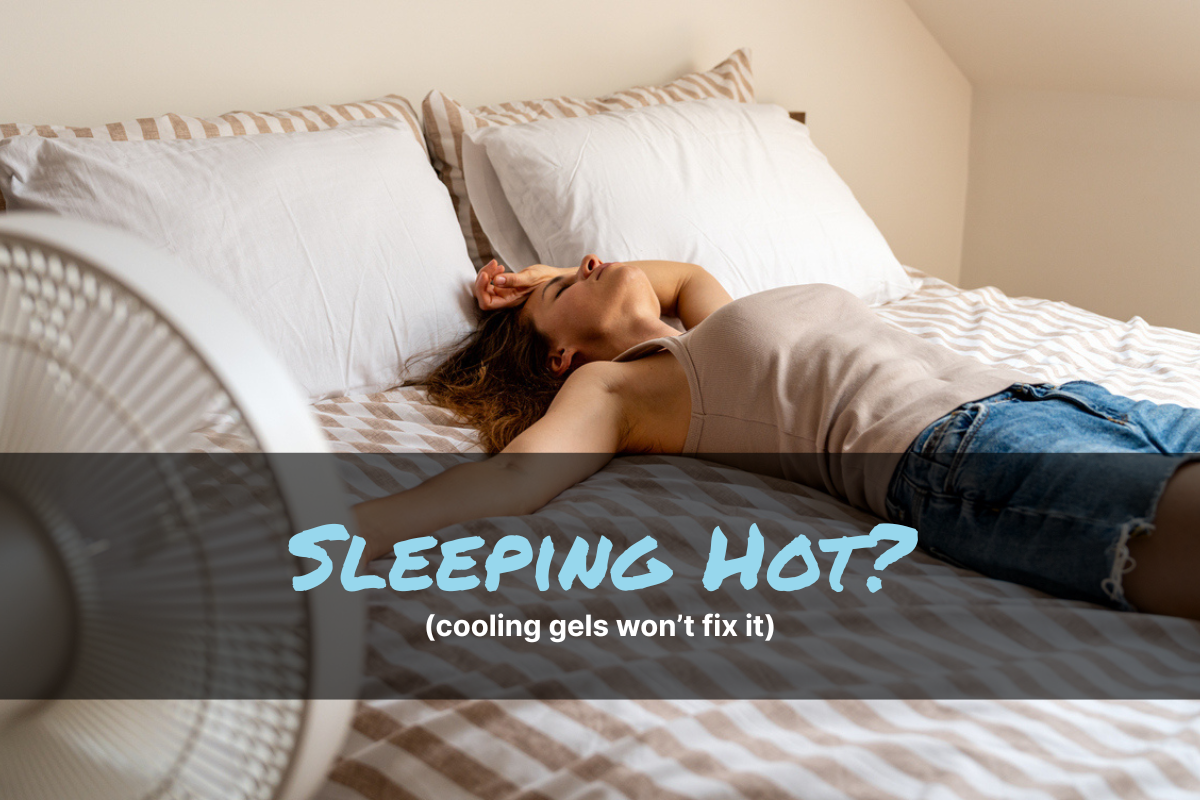
If you've ever woken up drenched in sweat on a supposedly "cooling" mattress, you've learnt an expensive lesson: marketing hype doesn't beat physics.
After spending 15 years making mattresses and solving heat complaints, I can tell you that most cooling technology is pure nonsense. The gels, the graphite foam stories, the "10 times more airflow" claims... it's all from the marketing department, not from anyone who's actually opened up a hot mattress to see what's going on inside.
Let me explain what's really happening when your mattress feels hot. (Prefer to watch rather than read? I've explained all of this in the video below.)
"Why is my mattress so hot?" : The frying pan analogy explains the physics
To understand why your mattress makes you feel hot, think about two frying pans: a thin one and a thick one. The thin pan heats up quickly but also cools down quickly because it has less volume of metal to absorb and store heat. The thick pan heats up more slowly but retains heat much longer. Its greater volume of metal allows it to absorb and store more heat energy.
Now apply this to your mattress. The volume of metal in the frying pan is like the volume of foam in your bed. Both store heat, but in different ways. The metal conducts and stores heat directly, while foam traps heat in its air pockets.
Let me give you two examples:
Mattress 1 (the "thin frying pan"): Just 2cm of foam sitting on top of springs.
Mattress 2 (the "thick frying pan"): 30cm thick with no springs at all, just solid foam.
Here's the point that most people miss: Mattress 2 has the ability to trap 15 times more heat than Mattress 1. Why? Because all that foam has significantly more volume to trap air and, consequently, heat. The springs are just air, and air is poor at storing heat. It actually dissipates the heat.
Mattress heat: The density problem
Research shows that less than 5% of owners of low-density memory foam beds complain of heat, versus over 12% of those with high-density beds. This isn't surprising when you understand foam density.
Your body temperature stays relatively constant at around 37°C, but your mattress doesn't generate heat. It traps the heat your body produces. When you lie on a memory foam mattress, your body heat warms the foam, and the foam stores that heat against your skin rather than allowing it to dissipate into the air.
The problem with memory foam is its structure. It has a tightly packed cellular structure, making it less breathable compared to traditional innerspring mattresses and reducing airflow. This dense structure is exactly what makes memory foam conform to your body so well, but it's also what makes it trap heat so effectively.
Here's what actually contributes to mattress heat, based on thousands of real-world adjustments I've made:
60% - Amount of foam
More foam equals more heat. Your mattress isn't hot. Your body is hot, and your body heats up the foam. If there's less foam, the foam can't heat up as much. Think of a thin-bottomed saucepan versus a thick-bottomed saucepan. Which one gets hotter and stays hotter longer?
This is the single most important factor. A mattress with 30cm of foam will sleep significantly hotter than one with 10cm of foam, regardless of what cooling technologies are added. It's basic thermal mass: more material means more heat storage capacity.
20% - Density of foam
If you have 10cm of foam, it's possible to have twice as much "material" in that same 10cm. Therefore, the more "material," the more heat. High-density foam will hold more heat than low-density foam.
To put this in perspective:
-
Air has a density of 1.2 kg/m³
-
Polyfoam (quality stuff) is around 35 kg/m³, which is 30 times more efficient at storing heat than air
-
Memory foam is 50-60 kg/m³, making it 46 times more efficient at storing heat than air
-
Tempur foam is 85 kg/m³, making it 70 times more efficient at storing heat than air (probably why so many reviews mention how hot they are)
When you sleep on a pure foam mattress, you're essentially sleeping on material that's extraordinarily good at holding onto your body heat. The higher the density, the worse the heat retention becomes.
15% - Type of foam
Latex comes from a tree; it's a natural substance. Every other foam on the market is plastic, a petroleum byproduct. In my experience, making mattresses with removable foam pieces, people can swap latex for polyfoam or memory foam to test. For heat-sensitive customers, they always end up keeping the latex because they say it's cooler.
I also believe the latex structure helps dissipate heat. It's got probably 3 times the surface area of polyfoam due to the massive holes all the way through it. The heat possibly has more surface area to interact with the air, just like a heatsink on a computer. Latex mattresses have massive holes taking up 20-40% of the mattress, which also helps dissipate heat and improve airflow.
Compared to memory foam, latex mattresses sleep considerably cooler. The open cell structure of latex creates interconnected air channels that promote airflow, whilst memory foam's closed-cell structure traps heat against your body.
5% - Type of fabric
Fabric is extremely thin. I have no idea how fabric is supposed to stop body heat from heating up the foam beneath it. After a mattress protector and sheets, how on earth is this layer supposed to change anything? I put 5%, but I think that's way too generous.
Even breathable bedding and cooling sheets can only do so much when you've got 25cm of dense foam underneath trapping all your body heat.
Why cooling gels and cooling technologies don't work
Companies claim "33% more airflow", or "10 times more air flow", or "feels 2 degrees cooler." These numbers are straight from the marketing department. If there were a scientific process for measuring mattress foam temperature differences, it would be helpful, but there isn't. The differences are so small that they're extremely difficult to measure.
Here's the reality: If there were a way to measure it accurately, we would be looking at numbers like 3% improvement rather than 1000%. But 3% doesn't market well. There is no data. Information without data is just a story or an opinion.
Modern memory foam incorporates cooling technologies such as gel-infused layers that maintain temperature within 2°F, but when you've got a mattress with 20-30cm of foam, a 2-degree difference isn't going to solve your sleep problems. You'll still wake up hot.
I believe these brands are trying to differentiate their mattresses the only way they can because they're selling a commoditised product. They're doing it with marketing messages. It's pretty standard across industries.
Every mattress company has come out with their own "proprietary" foam: "Kloudcell," their own brand names for springs, "Titanium," "Motherboard." They all compete in the marketing realm rather than solving the actual physics problem.
The gel-infused foam myth
Gel-infused foam was developed with "beads" containing gel, which, as a phase-change material, achieved temperature stabilisation by changing from a solid to a liquid state within the capsule. Sounds impressive, right?
The problem is that gel-infused memory foam still has the same fundamental issue: you've got a thick layer of dense foam that traps heat. The gel beads might help slightly at the surface level, but they don't address the core problem of excessive heat being trapped in the mattress structure below.
The phase change material distraction
Phase change materials might sound impressive, but they could actually have the opposite effect by distracting you from the things that are much more effective at stopping heat. Looking at technical specs may lead you away from solutions that actually work.
When I have a customer complaining about a hot mattress, I don't start adding cooling gel or phase change materials. I reduce the foam amount. It works every time.
The fundamental misunderstanding about sleeping hot
Here's what people don't realise: Mattresses themselves don't generate heat. They TRAP the heat your body produces. What you want is a mattress that allows this heat to dissipate more easily.
When people ask me about the reason for heat, I point to the spring unit and say, "That's the coolest mattress you'll get. There's no foam and no fabric on it." However, it won't be very comfortable, so you need to add some padding.
The more padding/foam you add to it, and the softer it is, the more you sink in, the hotter it will get. Sinking in is like putting more clothes on. When your skin has less contact with the air, heat and humidity build.
This is particularly true for memory foam mattresses. Memory foam is temperature-sensitive, softening as it absorbs body heat to mould to your shape, which enhances comfort but also creates a warmer sleep surface. The very feature that makes memory foam conform to your body (its response to body temperature) is what makes it trap heat so effectively.
The comfort vs. coolness trade-off: what hot sleepers need to know
Here's the hard truth most people who sleep hot don't want to hear: You can't have a super comfortable AND super cool mattress. It's not anyone's fault, and there's nothing wrong with the materials. It's just physics. This is the way these types of materials behave, and there's not much we can do about it.
When a customer complains of heat problems, I always think to myself, "I bet the last mattress they had was a spring unit with barely any foam on it." When I ask them why they bought a new mattress, they usually say something along the lines of "I could feel the springs on the other one."
Then I explain that reduction of foam reduces heat storage in the mattress. I start to show them different combinations using less foam. After a while, they realise that there is a trade-off when it comes to comfort. Most people don't have heat issues, so mattresses are made fairly comfortable, and it works for almost everyone.
For those who do sleep hot, I ask them at the start of the process. Then I show them how we can trade off some comfort for coolness to maintain sleep quality.
Research supports this. When your mattress traps heat, it's working against your body's natural cooling process during sleep.
Memory foam mattress sleep hot: why your foam mattresses are the problem
If you're a hot sleeper with a memory foam mattress, you need to understand what's happening. Approximately 31% of memory foam users identify heat retention as their primary concern with their mattress. That's nearly one in three people experiencing excessive heat issues.
The heat retention issue stems from the dense cellular structure that makes memory foam effective at contouring. The same properties that allow the foam to mould to body shape can also limit airflow and trap warm air near the sleeping surface. This effect is particularly noticeable for naturally warm sleepers or those living in warmer climates.
Memory foam works by responding to your body temperature. As you lie on it, your body heat warms the foam, making it softer and more pliable so it can conform to your shape. But this also means the foam is continuously absorbing and holding your body heat throughout the night.
When you compare memory foam to innerspring mattresses, the difference becomes clear. Innerspring mattresses have coils that create natural air circulation channels. Air can move through the mattress structure, carrying heat away from your body. Foam mattresses, particularly all-foam constructions, don't have this benefit. The foam blocks air circulation, creating a thermal barrier that traps your body heat.
This is why hybrid mattresses, which combine foam layers with an innerspring system, often sleep cooler than pure memory foam mattresses. The coils in hybrid mattresses create pathways for air circulation that help dissipate heat, even though you still have foam comfort layers on top.
How your sleep environment affects heat retention
Your mattress isn't the only factor affecting whether you sleep hot. Your entire sleep environment plays a role in temperature regulation during the night.
Research shows that sleep was most efficient and restful when nighttime ambient temperature ranged between 20 and 25°C, with a clinically relevant 5-10% drop in sleep efficiency when the temperature increased from 25°C to 30°C. This means your bedroom temperature directly affects your sleep quality.
If you have a hot mattress in a warm room, you're fighting a losing battle. Your core body temperature needs to drop for you to enter deep sleep. About two hours before bedtime, the body begins to cool down, signalling that it is time to sleep. When your mattress traps heat, and your bedroom is warm, you're working against this natural process.
The role of mattress protectors and bedding
Non-breathable mattress protectors made from waterproof or synthetic materials can block airflow and trap heat, making it harder for your mattress to stay cool. This is something many people overlook when trying to solve heat problems.
I see this constantly: someone buys a cooling mattress, then wraps it in a plastic mattress protector and wonders why they're still hot. The protector creates a vapour barrier that traps heat and moisture between your body and the mattress.
If you tend to sleep hot, you need breathable mattress protectors made from natural fibres that allow air circulation. The same goes for your sheets. Cooling sheets made from breathable materials like cotton or bamboo can help, but they won't overcome a mattress with excessive heat retention.
What mattress type actually helps you sleep cooler
Based on my 15 years of making mattresses and adjusting them for heat complaints, here's what actually works:
Innerspring mattresses and hybrid mattresses
Innerspring mattresses sleep the coolest because the coils create natural air channels throughout the mattress structure. Air can circulate freely, carrying heat away from your body. When you combine this with a thin comfort layer (2-4cm of foam), you get a mattress that provides comfort without excessive heat retention.
Hybrid mattresses take this concept and add foam comfort layers on top of the innerspring system. They sleep cooler than pure memory foam mattresses because the coils underneath promote airflow, even though you still have foam on the surface. The key is keeping those foam layers relatively thin: the thicker the foam, the more heat it will trap.
Latex mattresses: the natural alternative
If you want foam comfort without the heat retention of memory foam, latex mattresses are your best option. Latex has an open-cell structure with large air holes throughout the material. These interconnected air channels improve airflow and help dissipate heat.
In my experience, when heat-sensitive customers test latex versus memory foam or polyfoam, they consistently choose latex because it sleeps cooler. The natural properties of latex, combined with its holey structure (20-40% of the mattress volume is air channels), make it significantly better at temperature regulation than synthetic foam mattresses.
Latex also doesn't respond to body temperature the way memory foam does. Memory foam softens with heat, creating more surface contact with your body and trapping more heat. Latex maintains its structure regardless of temperature, which means less body contact and better air circulation around your body.
What about cooling mattress toppers and mattress pads?
A cooling topper or mattress pad won't fix a fundamentally hot mattress. If you've got 25cm of dense memory foam underneath, adding a 5cm cooling topper on top isn't going to solve your problem. You're just adding more foam, which means more heat storage.
Mattress toppers and mattress pads can make a small difference if you have a mattress that's close to comfortable but slightly too firm or too hot. But they're not a solution for a mattress with severe heat retention issues. In that case, you need a different mattress with less foam or better air circulation.
How to fix a hot mattress: practical solutions
Now that you understand why your mattress makes you feel hot, let's talk about what you can actually do about it.
Reduce foam amount
Less foam = less heat. It's simple and actionable.
If I'm making a mattress for someone with excessive heat issues and I want something on the extreme end of coolness, I would add just 25mm of foam. Any less and the springs would be too apparent; any more and you're just adding heat.
I make something like this maybe 1 in 100 times, because the Aurora and Cloud already provide a good balance of temperature and comfort for most people. But for true hot sleepers, reducing foam amount is the single most effective solution.
Improve air circulation
Keep your bedroom cool. Research shows the optimal bedroom temperature for sleep is between 15.6 to 20 degrees Celsius for the most comfortable sleep. Use air conditioning if you have it, or a fan to keep air moving across your body.
Open windows to promote air circulation if outside temperatures are cooler than inside. The more air movement you have, the easier it is for heat to dissipate from your body and mattress.
Choose breathable bedding and natural fibres
Use breathable sheets made from natural fibres like cotton, linen, or bamboo. These materials wick moisture away from your body and allow air to circulate better than synthetic fabrics.
Choose breathable mattress protectors rather than waterproof plastic ones. Look for protectors made from breathable fabrics that allow air to pass through whilst still protecting your mattress.
Avoid warm bedding like heavy duvets if you sleep hot. Even if you have air conditioning, piling on thick bedding will trap heat against your body.
Consider your bed frame
Your bed frame affects air circulation beneath your mattress. A solid platform base blocks airflow underneath the mattress, whilst a slatted base or bed frame with gaps allows air to circulate below. This won't make a huge difference, but every little bit helps.
The only product that actually works: BedJet
Pumping air under the covers moves humidity out of the bed. I've used one for 5 years and use it every night, winter or summer. You can set the temp on your phone. If mine broke, I'd buy another one the same day.
It doesn't even need refrigerated air. It just pumps air that's closest to the ground into the bed. Half the issue is humidity, and this lowers humidity. Airflow under the covers solves the humidity problem. You can put it on very low, and there's a convection current running through the sheets. Power usage is very low since it's only servicing a very small area.
It's the only device like it. The guy who built it designed the NASA space suit temperature regulation.
How do I keep my mattress cool while sleeping? The right mattress matters
This is the question I get asked most often, and the answer isn't what people want to hear: you need the right mattress to begin with.
You can't fix a fundamentally hot mattress with accessories or bedding changes. If you have 30cm of memory foam, no amount of cooling sheets or breathable bedding will overcome the thermal mass of all that foam trapping your body heat.
The best mattress for people who sleep hot has:
-
Minimal foam layers (2-5cm maximum if you're truly heat-sensitive)
-
An innerspring system for air circulation
-
Latex instead of memory foam if you want foam comfort
-
Breathable materials throughout the construction
When people ask me what the best mattress is for hot sleepers, I always point them toward innerspring mattresses or hybrid mattresses with thin comfort layers. These provide adequate comfort whilst maintaining good air circulation.
If you prefer the feel of foam, latex mattresses are your best option. Natural latex has better temperature regulation than memory foam while still providing pressure relief and comfort.
"Why is my bed so hot when I lay down?" The immediate heat trap
When you first lie down on a memory foam mattress, it might feel fine. But after 15-30 minutes, you start to feel warm. After an hour, you're uncomfortably hot. Why?
Memory foam is temperature-sensitive, softening as it absorbs body heat to mould to your shape. This process takes time. As you lie there, your body heat gradually warms the foam. The foam softens, you sink deeper, creating more surface contact, which traps more heat, which warms the foam further. It's a feedback loop.
The foam beneath you absorbs your body heat and stores it. Because foam is poor at dissipating heat, that warmth builds up over time. After an hour or two, you've heated a significant volume of foam, and all that stored heat is radiating back at your body.
This is why people often wake up hot in the middle of the night rather than feeling hot when they first go to bed. The mattress has been absorbing and storing your body heat for hours. Eventually, there's so much heat stored in the foam that your body can't dissipate heat fast enough to maintain a comfortable temperature, and you wake up sweating.
Innerspring mattresses don't have this problem because the coils don't store heat. Air passes through the coils, carrying heat away continuously throughout the night. Even after hours of sleep, an innerspring mattress with minimal foam stays relatively cool.
Night sweats vs. hot mattresses: understanding the difference
Some people experience night sweats for medical reasons unrelated to their mattress. Hormonal changes, medications, infections, and other health conditions can cause excessive sweating during sleep.
However, if your night sweats started after getting a new mattress, particularly a new memory foam mattress, the mattress is probably the culprit. A hot mattress can cause otherwise healthy people to sweat excessively during the night.
The way to tell the difference: if you wake up sweating and your bed is dry, it's probably medical night sweats. If you wake up and your sheets are damp where your body was, and the mattress surface feels warm, it's heat retention from your mattress.
For people with medical night sweats, getting this right becomes even more important. You're already producing excess heat and moisture, so the last thing you need is a mattress that traps it all against your body.
What about breathable materials and open-cell structure?
Some memory foam mattresses advertise an open-cell structure to improve breathability. This is better than traditional closed-cell memory foam, but it doesn't solve the fundamental problem.
Yes, an open-cell structure allows slightly more air movement through the foam. But you still have a thick layer of dense material that stores heat. The improvement is marginal, maybe 5-10% better than closed-cell foam, but still dramatically worse than innerspring mattresses or latex mattresses.
Breathable materials in the cover layer can help wick moisture away from your body, but they don't prevent heat from being trapped in the foam layers underneath. It's like having a breathable shirt whilst wearing a thick winter coat. Sure, the shirt breathes, but you're still going to overheat.
Better temperature regulation: the simple truth
Here's the simple truth about better temperature regulation in your mattress: reduce the thermal mass.
The marketing industry wants you to believe that technology solves everything. They want to sell you cooling gel, phase change materials, graphite-infused foam, and every other innovation they can think of. But these technologies are addressing symptoms, not the root cause.
The root cause is simple: too much dense foam trapping too much heat.
The solution is equally simple: less foam.
I understand this isn't the answer people want to hear. People want to believe they can have an ultra-plush, sink-into-it mattress that also sleeps cool. But physics doesn't work that way.
The bottom line for hot sleepers
Foam amount is the greater predictor of heat, and it trumps everything else. Focus on that first. All other things being equal, latex, in my opinion, will be the cooler foam, as long as it's not thicker.
When it comes to cooling technology, I could be wrong (there may be something that works) but I haven't seen anything that works. Phase change materials, cooling covers, gel-infused foams: they distract from what actually matters.
Simple rules of thumb are needed when educating people on mattresses. There are far too many variables, and this is why people are so confused and frustrated. Keep it simple:
Less foam = less heat.
More you sink in = more heat.
Springs dissipate heat; foam traps it.
Everything else is just noise.
My opinions are purely anecdotal based on my findings in my business. I can swap parts in and out of mattresses due to my modular system. If I don't cool the mattress down for some people, they want a refund. It's my responsibility to make sure the mattress is cooler or they get refunded. The best way I've found to do this is by reducing foam. Changing foam type kinda works sometimes, but reducing foam works every time.
I think people need simple rules otherwise they won't be able to action anything. Maybe different memory foams and polyfoam formulations and densities have cooler and warmer properties, but when speaking to 90% of people, they can't action this information. Simple rules of thumb are needed when educating people on mattresses. There are far too many variables and this is the reason why people are so confused and frustrated.
Key takeaways
Here's what you need to remember about hot mattresses and heat retention:
-
Foam amount is everything: The volume of foam in your mattress is the single biggest predictor of heat. More foam equals more heat storage. If you sleep hot, you need a mattress with minimal foam layers.
-
Memory foam is the worst for hot sleepers: Memory foam mattresses have dense cellular structures that trap heat exceptionally well, up to 70 times more efficiently than air. High-density memory foam is particularly problematic for heat retention.
-
Cooling technologies are mostly marketing: Gel-infused memory foam, cooling gels, phase change materials, and other cooling technologies provide marginal improvements at best. They don't address the root problem of excessive foam trapping heat.
-
Innerspring and hybrid mattresses sleep coolest: Mattresses with spring coils create natural air circulation channels. When combined with thin comfort layers (2-5cm), they provide the best temperature regulation for hot sleepers.
-
Latex mattresses are the coolest foam option: If you want foam comfort without memory foam heat retention, latex mattresses are your best choice. The open cell structure and natural air channels in latex dissipate heat much better than synthetic foam mattresses.
-
Your sleep environment matters: Keep your bedroom between 15-20°C, use breathable bedding and mattress protectors, and improve air circulation with fans. However, these measures won't overcome a fundamentally hot mattress.
-
Sinking in creates heat: The more you sink into your mattress, the more surface contact you have with the foam, which traps more heat. Firmer mattresses that keep you more "on" the surface sleep cooler than plush mattresses that let you sink "in."
-
There's a comfort vs. coolness trade-off: You can't have an ultra-plush, sink-into-it mattress that also sleeps cool. Physics doesn't allow it. Hot sleepers need to sacrifice some plushness for better temperature regulation to achieve comfortable sleep.
The path to better sleep for hot sleepers isn't found in expensive cooling technologies. It's found in understanding the basic physics of heat retention. Focus on reducing foam amount, improving air circulation, and selecting materials that naturally dissipate heat rather than trap it.
FAQ: Your hot mattress questions answered
About the author

Karl is the owner of Ausbeds. He started the company after realising how many people were frustrated by mattresses that failed too soon and too often. So he built a workshop in Sydney and began making mattresses the way they should be made - with transparent materials, adjustable designs, and customer-first thinking. When he's not in the showroom/workshop, he's on Reddit, Whirlpool, and OzBargain, cutting through industry fluff with honest mattress advice.