Mattress Marketing Gimmicks & Myths
The "exclusive" model
The biggest trick in the book involves price comparisons.
Let's say you walk into a store like Harvey Norman or Snooze. You find a Sealy model you like. You take a photo of the label, intending to check if another shop has it cheaper.
You often won't find it.
Big brands manufacture the exact same mattress (same springs, same foam, same support system) but they give it a different name and a different ticking (fabric cover) for every major retailer. At one store, it's the "Royal Cloud". At another, it's the "Posture Elite."
They do this to protect the business of the retailer. If you can't compare, they don't have to compete on price. It is a deliberate strategy to prevent you from finding the best price. When you ask a salesperson to price match, they will tell you the other bed is "completely different" because of some minor variation in the quilting. It is usually a lie.
This creates a market where potential customers cannot assess value. You are forced to trust the brand image or the salesperson.
The permanent discount
"50% off! Ends Sunday!"
This is the oldest trick in retail. Don't fall for the urgency of a sale.
The mattress industry is notorious for setting an artificially high RRP. A mattress might be listed at $4,000, but it is always on "sale" for $2,000. The mattress was never worth $4,000. The business model requires the perceived discounts to trigger a quick decision. They want you to worry that you will miss out.
I run Ausbeds differently. We set a fair price based on the cost of materials plus a reasonable margin to keep the factory lights on. We don't do sales. When customers realise the "half price" bed at the big store is still more expensive than our factory-direct price, the illusion breaks.
Fancy foams
Foam is the most important component for the comfort layer, yet it is where the most jargon exists.
You will hear terms like "gel-infused", "copper particles", or proprietary names that sound scientific. Ignore them. Most of the time, this is just marketing fluff for polyurethane foam.
There are really only three things that matter with foam: type, density, and whether it is open or closed cell.
Open cell foam vs. closed cell foam
This is a technical detail that affects your sleep quality massively, especially for hot sleepers. Mattress shops never tell you this. They will sell you a memory foam mattress that feels great for five minutes in an air-conditioned store, but leaves you sweating at home.
Memory foam is typically a closed-cell foam. It feels lovely and pressure-relieving when you first lie on it, but because the cells are closed, air cannot circulate. It traps your body heat. This is why so many hot sleepers wake up sweating in the middle of the night.
I prefer open-cell foam. Air can pass through it. It doesn't trap heat the way closed-cell foams do. Whether you choose latex or a high-quality polyurethane, asking about the cell structure is far more useful than listening to a pitch about "NASA technology".
Real latex is open-cell: natural, breathable and durable. It doesn't have that "sinking in" quicksand feeling. It is a fantastic material, but it is expensive, which is why many mattress brands use a tiny layer of it and call it a "latex mattress" when it is mostly cheap foam underneath. On my beds, I use a 5cm slab of high-quality latex. Just enough comfort layer so as not to feel the springs underneath.
Density and durability
The durability of a mattress is determined by the density of the foam. In the mattress industry, quality is weight.
Lower-density foams (under 30kg/m3) are cheap. They feel soft initially but collapse within a year or two. This is why you see body impressions (sags) in relatively new mattresses.
High-density foams (35kg/m3 and up) cost more to produce but last much longer.
Most mattress stores will not tell you the density. They hide it behind those fancy names. If a salesperson cannot tell you the density of the foam layers, be wary.
Mattress zones
When I started making mattresses, I was told I needed zones. When I stopped using them, my returns went way down.
The problem is, women typically have bigger hips and smaller shoulders than men, while men have bigger shoulders and smaller hips. So they'd need opposite zoning to each other - doesn't make much sense when you think about it.
I reckon manufacturers put zones in because they think they have to meet market expectations. It sounds fancy and technical, and you can charge more for "9-zone" versus "3-zone."
Instead of zones, we use a honeycomb spring arrangement that fits 30% more springs and gives better support distribution without uncomfortable hip zones. It's a more honest approach that actually works better.
Bed-in-a-box: the 100-night trial
A Reddit user I saw recently mentioned that the "100-day guarantee is probably the only good thing that happened to the industry." I agree.
Buying a mattress after lying on it for ten minutes in a shop is absurd. You are fully clothed, self-conscious, and a salesperson is hovering over you. You cannot know if a bed will fix your back pain until you sleep on it for a few weeks.
The 100-night trial (or similar) is good for consumers. It shifts the risk from you to the manufacturer. If the mattress causes pain, you send it back.
But returned mattresses are a logistical nightmare. Some companies donate them, but many end up in a landfill. The cost of these returns is baked into the price of every new mattress. If a company has a high return rate, its prices are way higher to cover the loss.
This is why reviews and transparency on the website are important. I can't afford to have a high return rate. I rely on keeping my customers happy so I can keep selling mattresses at a reasonable price.
At Ausbeds, we go further than 100 nights. We offer a 7-month trial with 2 free firmness swaps, because we'd rather adjust the mattress to fit you than take it back. Adjusting is better for you, better for us, and better for the environment.
The orthopaedic mattress
People often confuse support with firmness.
Support comes from the core: the spring unit or the base foam. It keeps your spine aligned.
Firmness creates the immediate feel, how hard or soft the surface is.
You can have a soft mattress with excellent support, and a firm mattress with terrible support.
Retailers often push people with back pain toward "orthopaedic" firm mattresses. This is outdated advice. If a bed is too firm, it creates pressure points on your hips and shoulders. You need comfort layers to contour to your body while the springs do the heavy lifting.
Coil count is not a myth
There is a prevailing idea online that this is just another gimmick. I disagree. The logic behind a high coil count is sound, if done right.
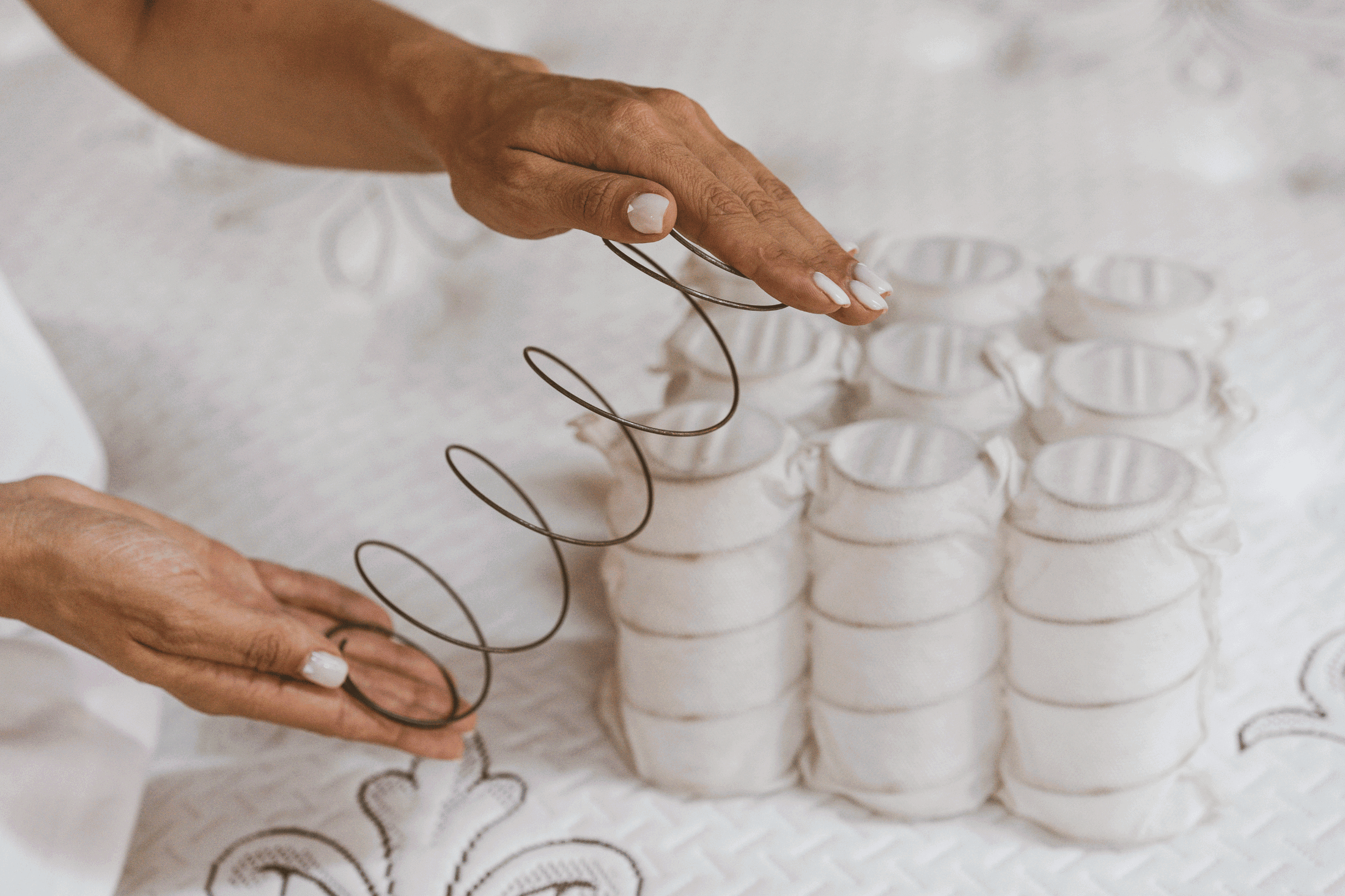
Think of coils like the pixels on a screen. A mattress with a low coil count (say, 300 springs) acts like a low-resolution image. If you press down on one spring, a large area of the bed moves. It doesn't contour to your body shape very well.
A mattress with more coils (say, over 800 pocket springs) offers a higher resolution of support. Each spring works independently. It can follow the curve of your spine, dipping for your hips and supporting your lower back.
However, the coil count is only half the story. The wire gauge (thickness) is equally important. This is where physics comes into play. You cannot put a 120kg rugby player on a soft, thin gauge spring and expect it to last. Conversely, a 50kg person on a thick, heavy-gauge spring will feel like they are sleeping on a table.
The wire gauge should be matched to your body weight. A firm mattress is not always better for your back; the right support is better for your back. This means matching the springs to the person. That is mechanics, not a gimmick.
How we do it at Ausbeds
I mentioned I run a factory. We cut out the middleman.
When we build a mattress, we focus on high-quality latex and pocket springs. We don't use mystery layers or "cloudcell technology".
Here is my advice for potential buyers navigating the market:
- Ignore the name: Don't try to compare names across stores. Look at the specs.
- Ask about density: Ask the staff, "What is the density of the foam in kg/m3?" If they don't know, or if they say it's "commercial secret," walk away.
- Check the spring gauge: Don't worry about coil counts over 1,000. Ask about the wire gauge and if it's suitable for your body weight.
- Look for open cell: If you are a hot sleeper, ensure you are getting open-cell foam like latex. Avoid cheap memory foam.
- Read independent reviews: Look at ProductReview.com.au or Google reviews. Look for how the business handles complaints. Every company gets bad reviews, but good companies resolve them.
- Value the trial: Ensure you have the option to return or adjust the mattress. At Ausbeds, we allow you to swap layers and upgrade parts to change the feel, which saves the mattress from being returned.
Summary
The mattress industry relies on the fact that you don't know what is inside the white rectangle. They use marketing gimmicks, inflated prices, and confusing names to keep you guessing.
Quality is not magic. Quality is good materials assembled well. It is high-density foams, tempered springs, and breathable fabrics.
When you shop, look for transparency. Look for a store or website that explains what's inside, rather than blinding you with science. You spend a third of your life in bed. You deserve to know what you are paying for.
Written by Karl van Lieshout, Founder of Ausbeds. Mattress maker in Marrickville, Sydney since 2012.
About the author

Karl is the owner of Ausbeds. He started the company after realising how many people were frustrated by mattresses that failed too soon and too often. So he built a workshop in Sydney and began making mattresses the way they should be made - with transparent materials, adjustable designs, and customer-first thinking. When he's not in the showroom/workshop, he's on Reddit, Whirlpool, and OzBargain, cutting through industry fluff with honest mattress advice.